
|
PlanetLab Visualizer 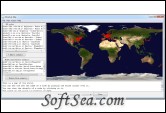
|


PlanetLab Visualizer is a software package that creates maps for visualizing the PlanetLab network. The software can either request data from Sophia if the user provides a Prolog query, or from raw data entered by the user or generated by an external script. The user specifies how to draw nodes (PlanetLab machines) and edges (arbitrary relationships between PlanetLab machines) via a view file. The view file also contains a reference to the image file on which to draw the nodes and edges, as well as the latitudes and longitudes that the map spans. There are several Java programs that perform different actions:
1. PlanetlabDesktop is a stand-alone GUI application that displays maps on the screen and gives the user the ability to quickly modify existing view files (which specify queries, data, and how to draw nodes and edges from the data).
2. PlanetlabDisplayWall is a stand-alone GUI application like PlanetlabDesktop that displays the generated maps on the display wall in Princeton University's computer science building.
3. PlanetlabImage is a command-line program that, given a view file, creates a JPEG map and writes it to disk.
4. PlanetlabDescription is a command-line program that, given a view file, creates instructions that a graphical program (such as a PHP script) can use to generate the map. This is what the web version of the visualizer uses.
5. PlanetlabNode is a command-line program that, given a node view file and a node number, outputs information about the node. The web version executes this program when the user clicks on a node.
6. PlanetlabWeb is a package of PlanetlabDescription, PlanetlabNode, and a couple PHP scripts that can be used to setup a webpage that displays PlanetLab maps.
Features:
1. Viewing all PlanetLab nodes on world maps
2. Adding nodes to your PlanetLab slice
3. Viewing which nodes belong to your slice
4. Show detailed information about a node like its boot state or the bandwidth limit
5. Deploying software to nodes
6. Starting execution of an experiment
7. Copying of directories from the nodes to your localhost (e.g. experiment results)
8. You can select some nodes for a scenario to do experiments with them, and save the scenario configuration for later use.
9. Ability to develop your own experiment logic using Java
To run experiments you'll need Java programming experience and some time to learn the architecture of the PlanetLabVisualizer and the PlanetLabClient. The Client is the piece of (Java) software that runs on each node taking part in the experiment.
The Visualizer lets you deploy your own written experiment software to the nodes of your slice. It allows you to run this software on the nodes and through RPC you can collect the results or check the current state of your software. The default experiment software
is located in the deployDir/PlanetLabClient.
Requirements:
* Java
The license of this software is Free, you can free download and free use this application software.